
By Sala Traju Association
In international relations, intent is rarely declared outright. It is revealed through choices. When a state closes negotiation channels, abandons binding agreements, and escalates militarily, those choices form a pattern. Today, Thailand’s recent actions toward Cambodia raise an unavoidable question: Has Thailand decided that negotiation is no longer part of the solution?
International law is unambiguous. Article 2(3) of the United Nations Charter obliges states to resolve disputes by peaceful means, including negotiation. This obligation exists precisely to prevent disagreements from sliding into coercion or conflict. Yet Thailand’s recent conduct suggests a deliberate retreat from that framework.
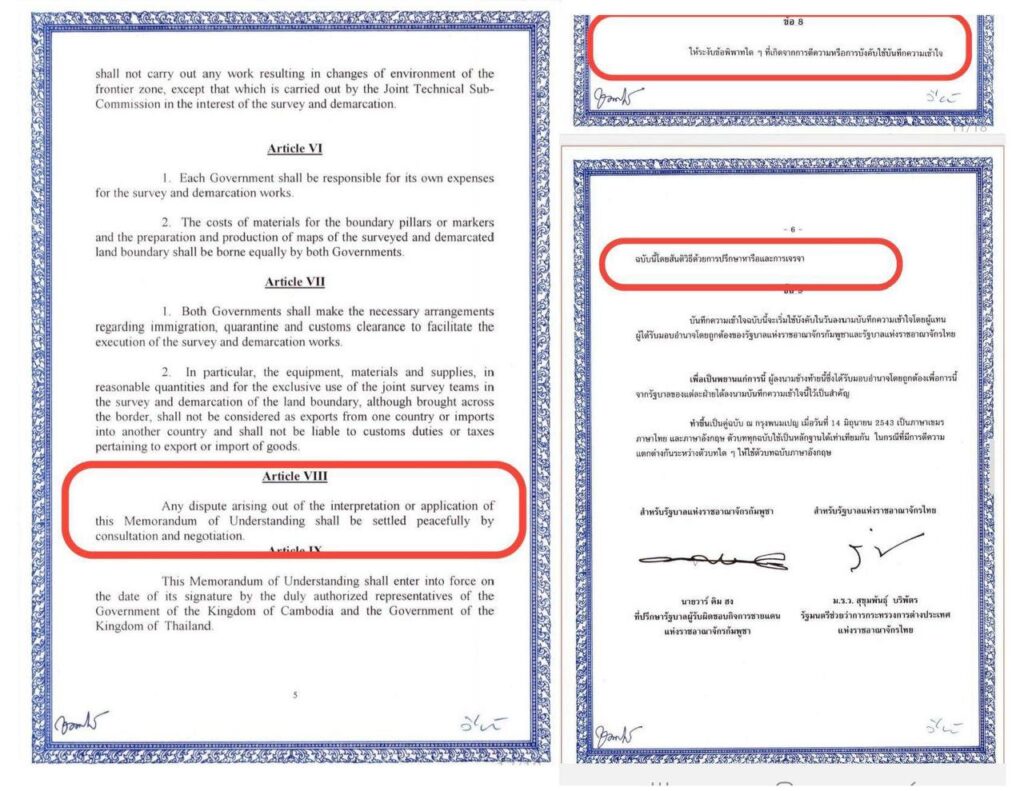
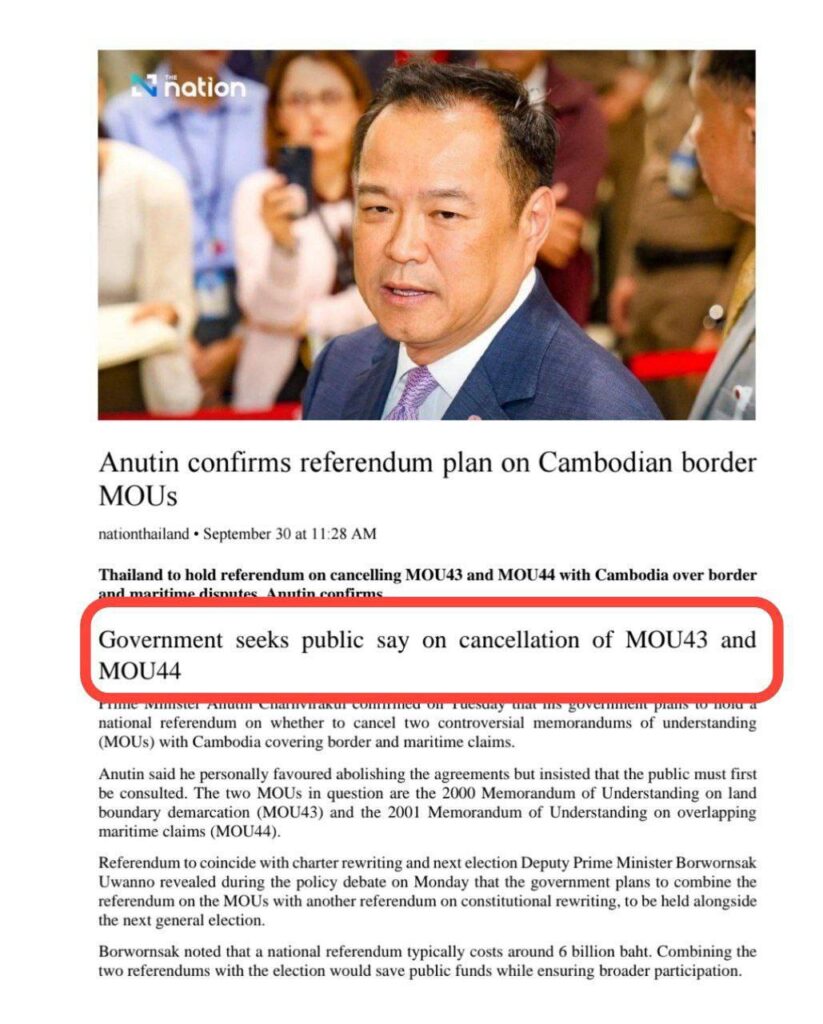
First, Thailand has moved to dismantle the legal architecture that makes negotiation unavoidable. Between September and October 2025, the Thai government has signaled its intention to cancel the 2000 Memorandum of Understanding on land boundary demarcation through a national referendum.¹ This agreement does not award territory to either side. What it does is bind both parties to consultation and negotiation. Article VIII of the MOU is explicit: disputes “shall be settled peacefully by consultation and negotiation.”
The reason for Thailand’s discomfort with the MOU is therefore revealing. The agreement imposes obligations. It restrains unilateral action. It prevents force from replacing process. For a state that no longer wishes to negotiate, such an agreement becomes an obstacle rather than a safeguard.
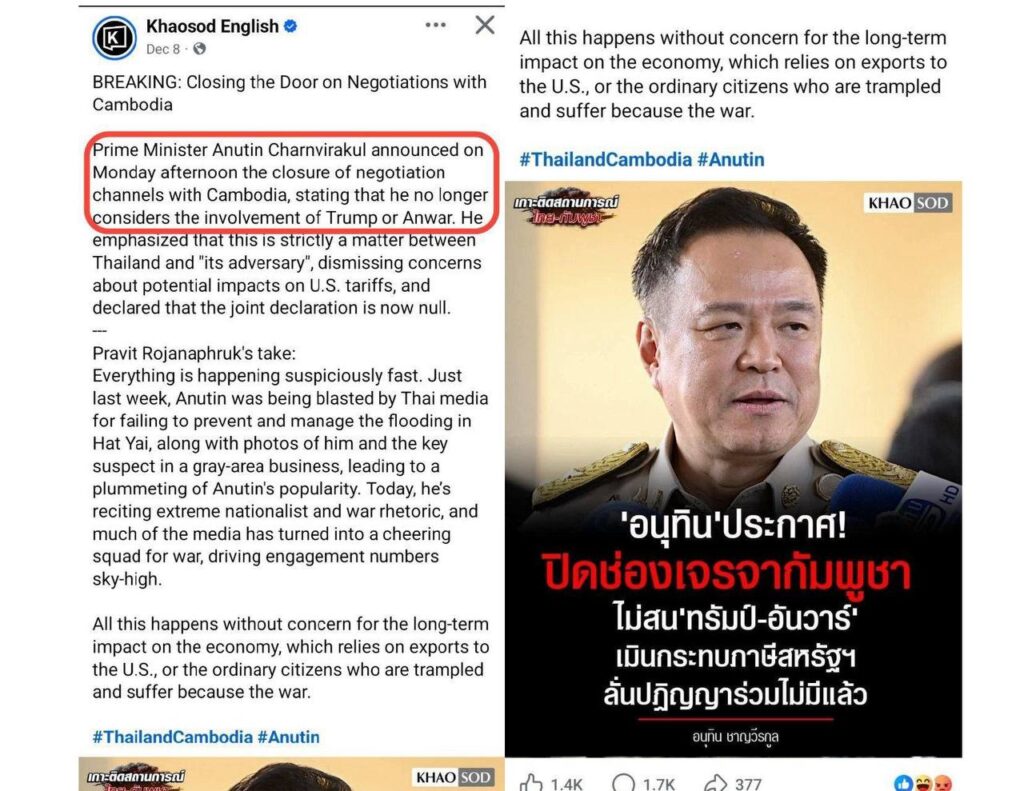
Second, in December 2025, Thailand has publicly closed the door to negotiations. Prime Minister Anutin Charnvirakul has announced the termination of negotiation channels with Cambodia, explicitly rejecting third-party involvement and declaring that previous joint understandings are no longer valid.² This is not diplomatic ambiguity. It is a clear statement of refusal to engage in peaceful dispute settlement.
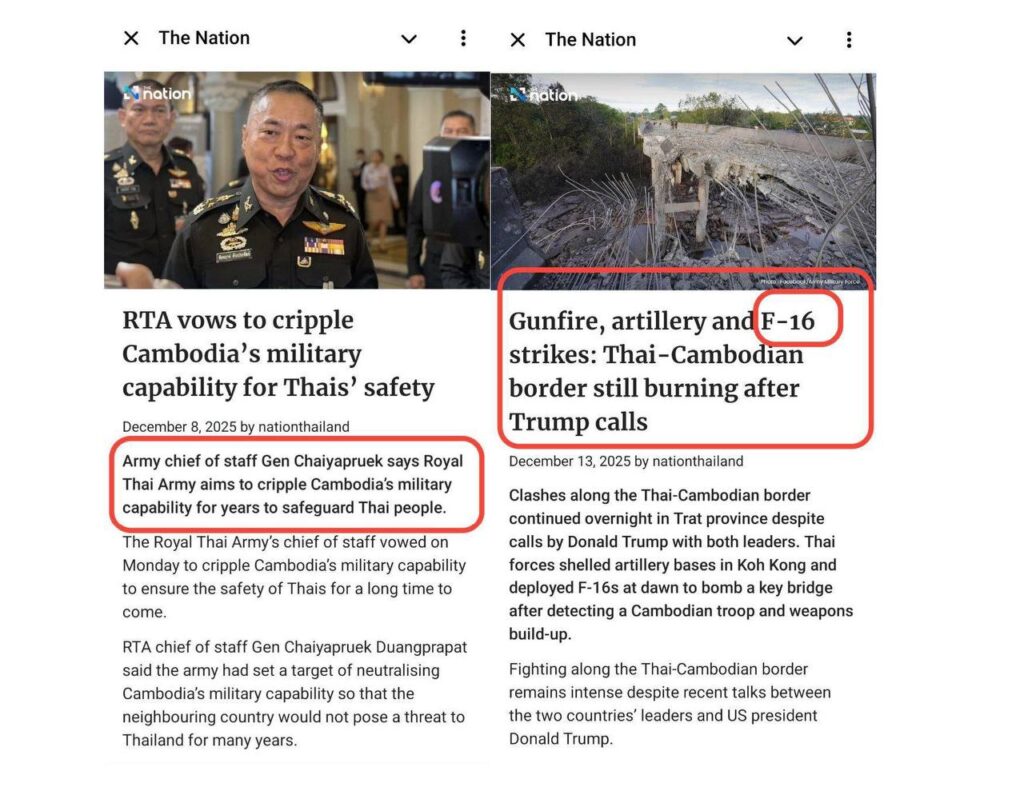
Third, December 2025, Thailand’s military posture has escalated in both tone and substance. Senior figures in the Royal Thai Army have publicly stated that their objective is to “cripple Cambodia’s military capability for years” to ensure Thailand’s security.³ This is not the language of containment or deterrence. It signals a long-term strategy aimed at degrading a neighboring state’s capacity. The deployment of advanced military assets, including F-16 fighter jets, further underscores that this is not spontaneous self-defence but coordinated planning.
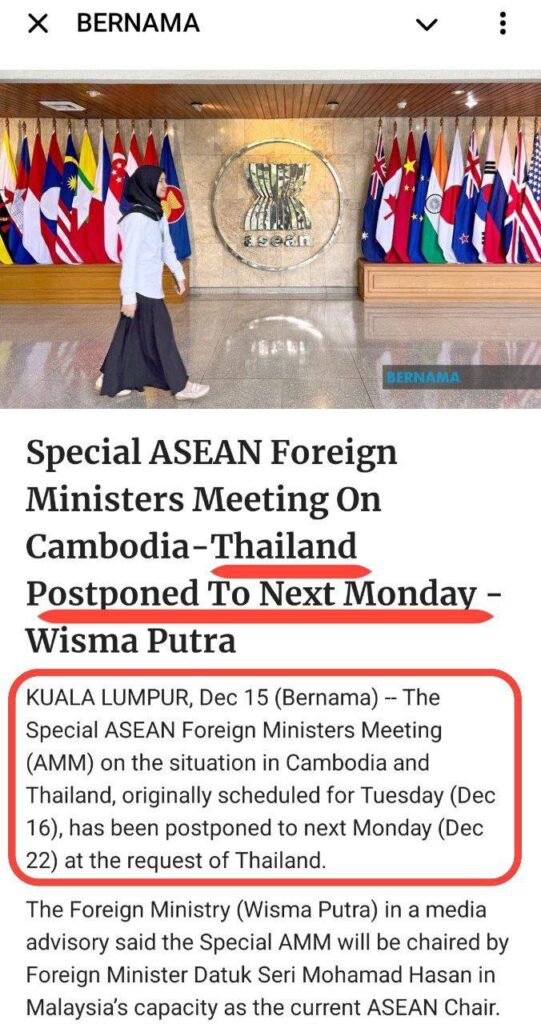
Fourth, Thailand has delayed regional diplomatic engagement. A special meeting of Southeast Asian foreign ministers, where senior diplomats from both sides could have met—was scheduled earlier this month but was postponed to 22 December at Thailand’s request, according to Malaysia’s foreign ministry.⁴ At a moment of heightened tension, delaying a regional forum designed for dialogue is not neutral. It is a choice to defer negotiation when it is most needed.
This conduct also conflicts with Article 33 of the UN Charter, which requires parties to a dispute likely to endanger international peace and security to seek, first of all, solutions through negotiation, mediation, or resort to regional arrangements. Peaceful settlement is not optional; it is a legal obligation. Thailand’s rejection of talks, resistance to third-party involvement, and postponement of ASEAN-level engagement indicate a failure to exhaust these required avenues.
Taken together, these three elements, refusal to negotiate, abandonment of binding agreements, and strategic military escalation, form a coherent pattern. They do not suggest miscommunication or temporary frustration. They suggest intent.
In international law, bad faith is not inferred lightly. It is assessed through conduct. A state acting in good faith does not close negotiation channels while claiming to seek peace. It does not discard agreements designed to manage disputes while insisting on stability. And it does not reject legal and diplomatic mechanisms while advancing military solutions.
Cambodia has repeatedly called for dialogue, adherence to existing agreements, and peaceful settlement. Thailand’s current posture points elsewhere: toward leverage instead of law, pressure instead of process.
The implications extend beyond this bilateral dispute. If treaties can be abandoned when they become inconvenient, they cease to be commitments. If negotiation is treated as optional, peaceful settlement becomes conditional. And if force replaces dialogue, the credibility of the international system weakens for everyone, especially smaller states.
This is not a question of who is right or wrong on the merits of territorial claims. It is a question of how disputes are resolved. Borders can be discussed. Claims can be examined. History can be debated. What cannot be normalized is the abandonment of negotiation itself.
Thailand still has a choice. Returning to the table would not signal weakness. It would signal seriousness, about law, about stability, and about regional responsibility.
If Thailand no longer wants negotiation, it owes the international community an honest answer about what it seeks instead. Because once negotiation is abandoned, what follows is no longer ambiguity, but accountability.
References:
- Khaosod English, “Closing the Door on Negotiations with Cambodia,” statement by Prime Minister Anutin Charnvirakul, 8 December 2025.
- The Nation (Thailand), “Anutin Confirms Referendum Plan on Cambodian Border MOUs,” September 29, 2025.
- The Nation (Thailand), “RTA Vows to Cripple Cambodia’s Military Capability for Thais’ Safety,” December 7, 2025.
- Reuters, “Thailand cuts Laos fuel route as Cambodia border conflict deepens,” 16 December 2025. Thailand cuts Laos fuel route as Cambodia border conflict deepens | Reuters
 ភាសាខ្មែរ
  English