
By Sala Traju Association
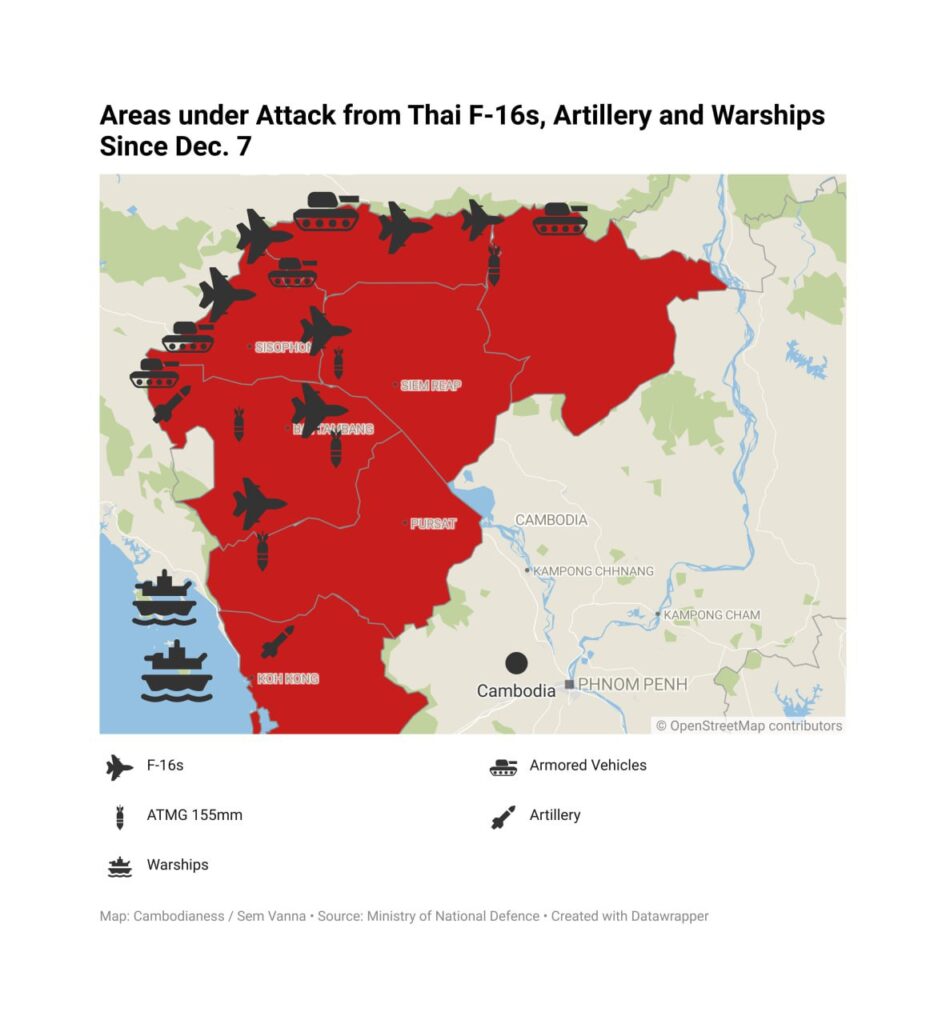
Since mid-2025, what began as a border dispute between Cambodia and Thailand has escalated far beyond isolated ground clashes. It is now clear that the Royal Thai Air Force has repeatedly used F-16 fighter jets to strike inside Cambodian territory, moving far beyond contested border areas and deep into Cambodia’s sovereign space, endangering civilians and violating fundamental principles of international law.
This escalation is no longer confined to disputed frontier zones. In addition, the escalation has not been limited to airstrikes. As fighting intensified in December, Thailand announced restrictions on fuel and arms transit routes, including measures aimed at preventing supplies from reaching Cambodia via Laos. Thai also signalled their intention to disturb Cambodia at sea. Thai naval officials have publicly proposed designating Cambodian ports as “high-risk” areas and restricting sea-borne shipments of fuel and other goods. Such measures go well beyond border security and amount to economic coercion with direct civilian consequences. In a letter to the U.S. Embassy, the American Chamber of Commerce in Cambodia warned that a port-based fuel blockade would force businesses to close and disrupt transportation, schools, and medical services for thousands of American civilians living in Cambodia.
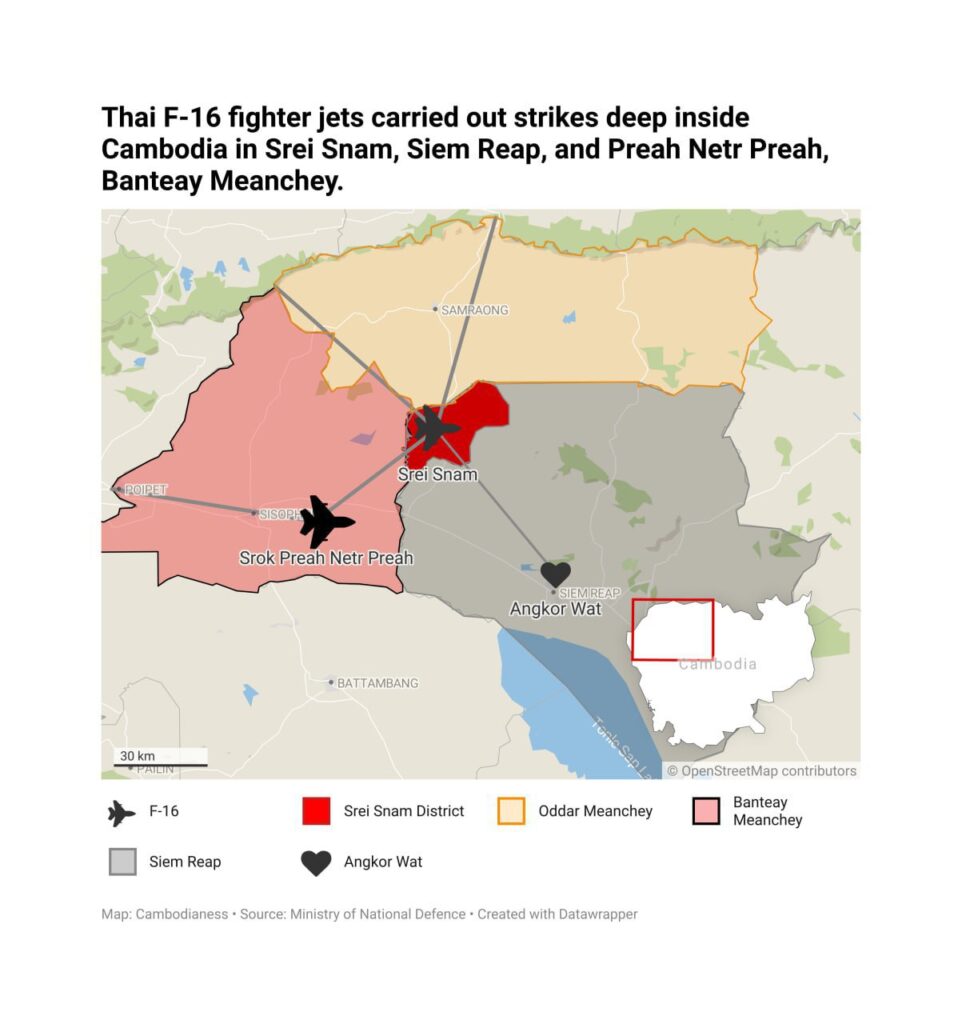
Furthermore, on December 15, 2025, Cambodia’s Ministry of Defence stated that Thai F-16 jets dropped bombs near a refugee camp in Siem Reap province, an area far from the immediate border and home to civilians displaced by months of fighting. Cambodian officials said the strikes endangered displaced people and damaged civilian infrastructure. Khmer Times reported that the attack occurred close to shelters for internally displaced families, compounding an already severe humanitarian situation.
This was not an isolated claim from a single source. Reporting by the Associated Press the same day documented intensified fighting and bombing deeper inside Cambodian territory. According to AP, Thai airstrikes came close to shelters for displaced civilians and destroyed a bridge in Siem Reap province—more than 80 kilometers inside Cambodia. The report underscored that the strikes were no longer limited to contested border areas but were reaching into zones previously untouched by the conflict.
The use of air power also fits into a broader pattern of escalation. Reuters reported in early December that Thailand launched airstrikes along the Cambodia border, with Thai officials saying their fighter jets struck Cambodian territory after accusing Phnom Penh of breaching a U.S.-brokered ceasefire. Cambodia denied the accusation, stating that it had not retaliated militarily and that it was continuing to observe agreed terms. The competing claims did not prevent further escalation.
This renewed aerial campaign follows earlier use of F-16s in the conflict. In July 2025, Thai F-16 jets were used in bombing runs near contested areas, including sites around the Preah Vihear region, marking the first major use of combat aircraft in the confrontation. While both sides had engaged earlier in artillery and rocket exchanges, the introduction of fighter jets represented a dangerous intensification of the conflict.
Independent international reporting paints a stark picture. Reuters has described heavy weaponry, drones, artillery, and air power being deployed along an 817-kilometer border that remains volatile after decades of unresolved dispute. What had once been episodic clashes has evolved into a sustained military confrontation with widening geographic reach.
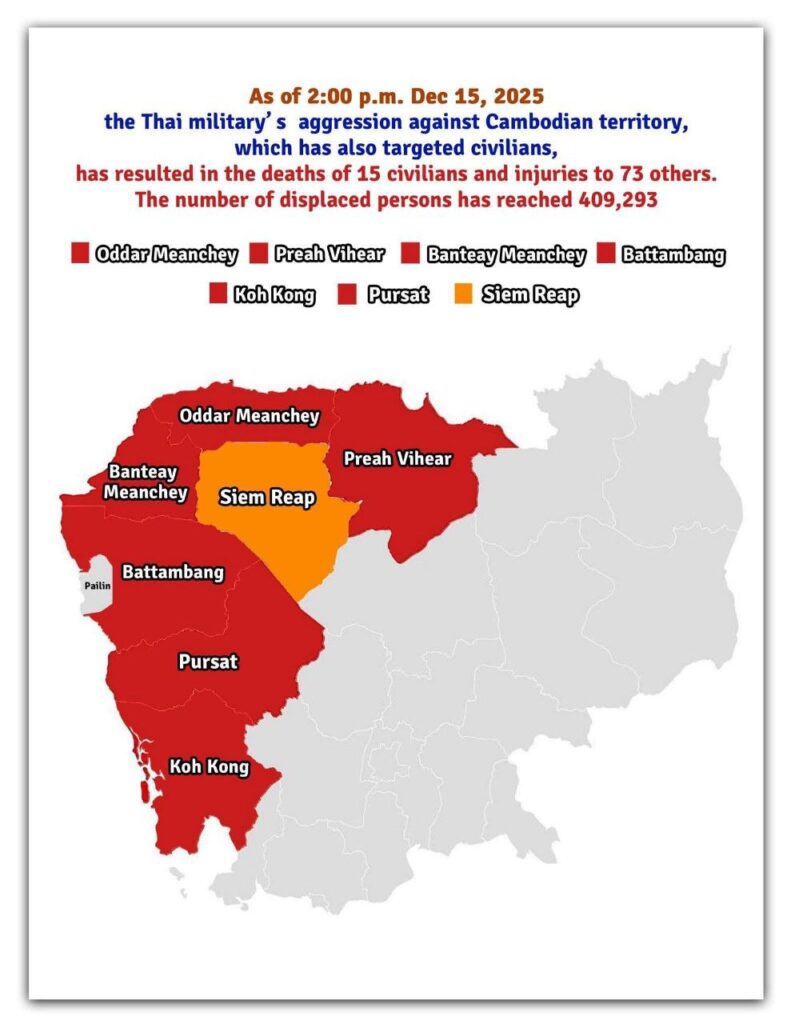
The human cost has been severe. Hundres of thousands of civilians have been displaced throughout northern Cambodia and adjacent Thai provinces. The Guardian reported in December that as many as half a million people had been forced from their homes as hostilities intensified. Other outlets have documented both military and civilian casualties, widespread disruption to livelihoods, and the repeated displacement of communities already struggling to cope with months of instability.
Diplomatic efforts have struggled to keep pace with the violence. Reports indicate that a ceasefire agreement brokered in October by the United States and ASEAN partners has largely collapsed, with both sides accusing the other of violations. International figures, including the American president, have urged restraint and a return to dialogue, but such appeals have had limited effect as military operations continued through December.
What distinguishes the current phase of the conflict is not only its geography but also its targeting choices. Airstrikes deep inside Cambodia, especially near refugee shelters, schools, and populated areas, raise serious legal questions. Military force is not inherently unlawful. Under Article 51 of the United Nations Charter, states may use force in self-defense if an armed attack occurs. But the Charter also prohibits the use of force against the territorial integrity of another state except in narrowly defined circumstances.
Unilateral cross-border air operations that strike civilian infrastructure far inside sovereign territory test the limits of what international law permits. Even claims of self-defense do not override the obligation to act within strict legal constraints.
International humanitarian law, codified in the Geneva Conventions and reflected in customary practice, imposes additional and non-negotiable duties. Parties to a conflict must distinguish at all times between combatants and civilians, and between military objectives and civilian objects. Attacks must be proportionate, and all feasible precautions must be taken to minimize harm to civilians.
Striking near refugee camps and in populated areas, particularly when the military nature of the targets is unclear, risks violating the principle of distinction. Reporting by the Associated Press indicates that at least some of the damaged structures included bridges, homes, schools, and religious buildings. These are not, by default, military objectives, and no publicly available evidence has shown that they were being used for military purposes at the time of the strikes.
Thailand’s military has justified some of its actions as necessary to neutralize Cambodian military threats. Reuters reported that Thai officials claimed their airstrikes targeted military positions after alleging that Cambodian forces had mobilized heavy weapons. But even if such claims are accepted at face value, legal self-defense must still satisfy the criteria of necessity and proportionality. Striking far beyond immediate conflict zones, particularly near civilians, undermines that justification.
Even within a context of mutual accusations, both governments have blamed the other for violations, the asymmetry of recent events is striking. Reporting by Reuters and Al Jazeera has described Cambodia as largely maintaining a defensive posture and not initiating an offensive that would justify extended air operations deep inside its territory.
This does not mean Cambodia lacks military capability. Both sides have engaged in artillery exchanges and ground clashes. But international law draws a clear distinction between fighting along a contested line and the use of high-performance aircraft to strike deep inside another state’s territory. Legal scholars have long emphasized that cross-border air operations carry a higher legal threshold, requiring clear evidence of imminent threat and strict adherence to humanitarian protections, a standard that current reporting suggests has not been met.
The broader regional context also matters. Both Cambodia and Thailand are members of ASEAN, whose charter commits members to the peaceful settlement of disputes and respect for sovereignty. Continued aerial operations extending beyond disputed border areas strain these commitments and weaken regional norms designed to prevent escalation.
In a world already crowded with conflicts where legality is brushed aside in favor of force, the Cambodia–Thailand confrontation is not a distant or marginal issue. It is a test of whether the rules governing the use of force still matter when advanced military power is brought to bear against a smaller neighbor.
Fighter jets crossing borders are not just military events. They are legal and moral thresholds. When those thresholds are crossed repeatedly, without restraint, the damage is not limited to bridges or buildings. It strikes at the foundations of an international order built to prevent war from becoming unmoored from law.
References:
- Khmer Times, “Thai F-16s Drop Bombs Near Cambodian Refugee Camp,” Khmer Times, December 15, 2025.
- Associated Press, “Cambodia Says Thai Bombing Is Hitting Deeper Into Its Territory Near Shelters for Displaced People,” AP News, December 15, 2025.
- Reuters, “Trump-brokered Truce under Threat as Thailand–Cambodia Fighting Reignites,” Reuters, December 8, 2025.
- Reuters, “Thailand Cuts Laos Fuel Route as Cambodia Border Conflict Deepens,” Reuters, December 15, 2025.
- The Guardian, “Half a Million Flee as Thailand–Cambodia Border Clashes Escalate,” The Guardian, December 11, 2025.
- China Daily Asia, “Cambodia Urges Thailand to Immediately Stop Military Operations,” China Daily Asia, December 2025.
- United Nations, Charter of the United Nations, June 26, 1945, arts. 2(4) and 51.
- International Committee of the Red Cross, Geneva Conventions of 1949 and Additional Protocols.
(Principles of distinction, proportionality, and precaution.) - Al Jazeera, “Deaths Mount on Fourth Day of Border Fighting between Thailand, Cambodia,” Al Jazeera, December 11, 2025.
- Phnom Penh Post, “AmCham President Warns US Embassy of Consequences of Thai Threats of Maritime Blockade.” Phnom Penh Post, December 15, 2025.
 ភាសាខ្មែរ
  English