
Editorial – Traju Bulletin Team
Wars are often explained as the result of ancient grievances or irreconcilable territorial claims. But many conflicts begin in a far quieter way: when a society decides that certain facts are no longer tolerable. That is what happened along the Thai–Cambodian border in 2025. The violence that followed was not inevitable. It emerged from a collective refusal to accept a basic technical truth about borders, and from the political consequences of that refusal.
For years, the Thai–Cambodian border had been addressed through a slow, imperfect, but functioning technical process. Under the 2000 Memorandum of Understanding (MOU43), Thai and Cambodian experts worked through the Joint Boundary Commission (JBC) to clarify a frontier of nearly 800 kilometers, much of it running through difficult terrain and areas never precisely demarcated in the colonial era. Thai officials themselves publicly affirmed that MOU43 carries the full legal weight of a treaty, does not redraw borders, and relies on joint surveys using modern technology. The two sides had previously undertaken extensive joint survey work, reaching agreement on boundary demarcation in numerous areas.¹
That process was still active in late 2025. On 21–22 October 2025, the JBC met in Chanthaburi, Thailand, where Cambodian and Thai technical teams agreed to advance joint survey work, finalize technical instructions, and continue clarification of disputed segments through non-prejudicial, field-based processes.² This progress was concrete, documented, and ongoing.
Then, on 23 October 2025, Cambodian Prime Minister Hun Manet publicly confirmed that concrete steps were being taken toward a peaceful, law-based resolution of the border issue, explicitly grounding Cambodia’s approach in joint technical mechanisms, surveys, and mapping rather than unilateral claims.³ Cambodian authorities emphasized that clarification was proceeding through field verification and technical assessment. A map shared by Prime Minister Hun Manet, drawn from technical survey data, visually illustrated what border experts had long understood: that areas described in Thai public discourse as “Thai villages” were, according to the technical survey, located within Cambodian territory.⁴
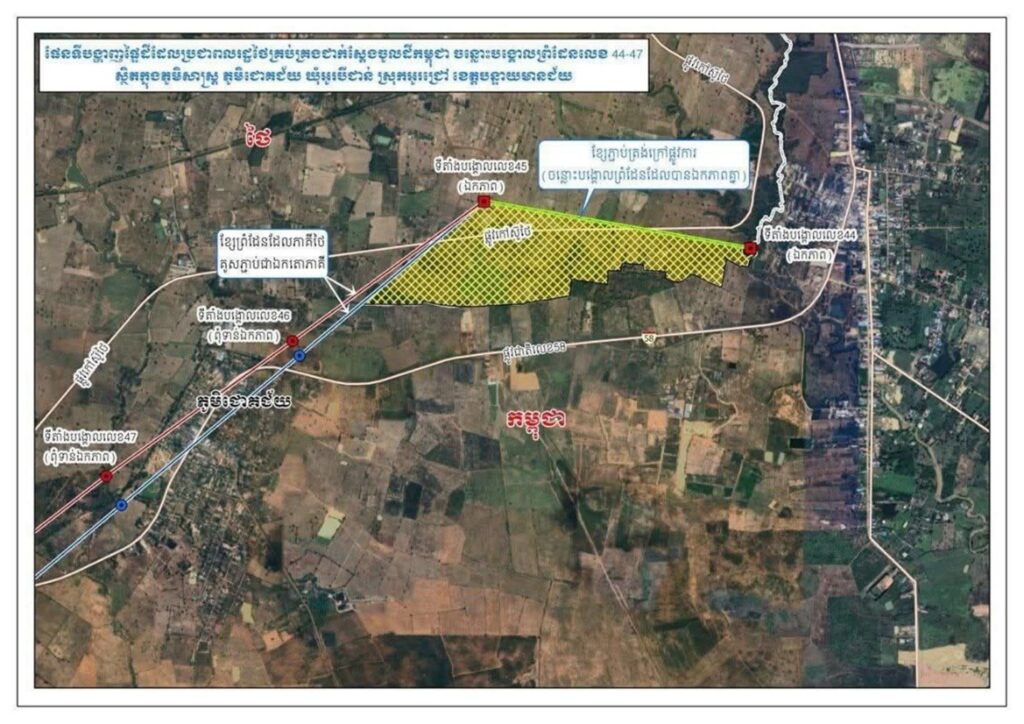
(Source: Samdech Hun Manet, Facebook post, 23 October 2025, explaining progress following the Joint Boundary Commission (JBC) meeting of 21–22 October 2025 and attaching technical survey maps relating to the Joak Chey and Prey Chan villages (between Boundary Pillars No. 42–47).
https://www.facebook.com/share/p/1C4jVALbP4/
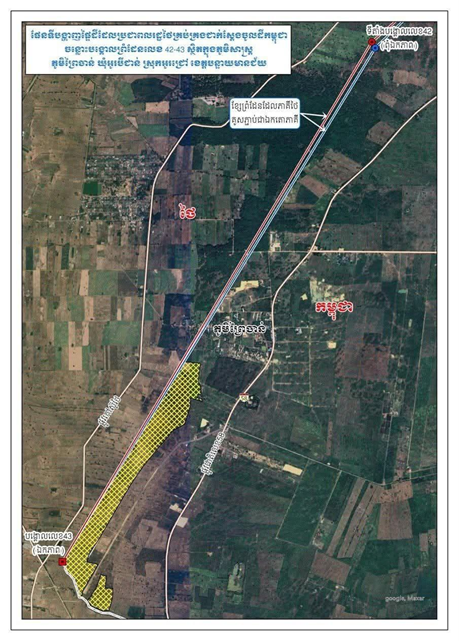
(Source: Samdech Hun Manet, Facebook post, 23 October 2025, explaining progress following the Joint Boundary Commission (JBC) meeting of 21–22 October 2025 and attaching technical survey maps relating to the Joak Chey and Prey Chan villages (between Boundary Pillars No. 42–47).
https://www.facebook.com/share/p/1C4jVALbP4/
This understanding was not uniquely Cambodian. On 27 October 2025, Thailand’s Deputy Prime Minister Anutin Charnvirakul publicly acknowledged, before nationalist backlash erupted, that encroachments had occurred on both sides as a matter of technical reality rather than political intent.⁵ Such acknowledgments are routine in boundary management. They do not concede sovereignty; they enable clarification.
Anyone familiar with historical borders understands this reality. When markers are absent or imprecise, communities inevitably cross lines that exist on maps but not clearly on the ground. This is not a political accusation. It is a technical condition, one normally resolved through surveys and negotiation.
When technical truth was established and law was available, Thailand chose force, not as an isolated decision of leaders, but as a reflection of a society that rejected factual complexity and rewarded coercive territorial encroachment over lawful resolution.
Within Thailand, this factual acknowledgment provoked intense backlash. Social media erupted in outrage. Commentators accused the government of surrender. The idea that borders could be historically messy and require expert clarification was rejected outright. What mattered was not accuracy, but emotional certainty. A technical explanation was transformed into a moral failure.
This was the critical turning point, not when shots were fired, but when facts became politically unacceptable.
Faced with mounting nationalist pressure, the Thai government reversed course. On 8 December 2025, flanked by senior military commanders, the prime minister announced that the National Security Council had authorized military action “in all circumstances,” replacing technical dialogue with the language of force.⁶
Escalation followed. Air operations were launched along the disputed frontier, civilians were displaced, and even the conservation facilities at the Preah Vihear World Heritage Site were damaged, drawing a formal response from India’s Ministry of External Affairs.⁷⁻⁹ The escalation did not result from a sudden diplomatic collapse. It resulted from a collapse in civic tolerance for factual complexity.
Borders are not expressions of emotion or identity. They are administrative and technical constructs shaped by history, terrain, and imperfect records. Resolving them requires patience, expertise, and a public willing to accept uncomfortable truths. When a society demands absolute moral clarity from inherently technical issues, it creates conditions in which force becomes easier than fact.
Responsibility, therefore, cannot rest solely with political leaders. Governments respond to pressure. When large segments of the public treat technical honesty as betrayal, leaders are incentivized to abandon explanation in favor of spectacle.
Cambodia, for its part, turned to law. On 15 June 2025, it formally petitioned the International Court of Justice seeking a definitive and peaceful resolution to the disputed areas.¹⁰ Thailand declined to participate. But beyond institutional choices lies a deeper question: whether a society is prepared to live with technical truth when it complicates national pride.
The border itself did not suddenly change in 2025. What changed was the public’s willingness to hear how borders actually work.
When citizens reject facts because they are inconvenient, conflict becomes not only possible but likely. And when a society chooses emotion over evidence, war begins long before the first shot is fired.
Footnotes
- Nation Thailand, “MOU43 Clarifies Thai–Cambodian Border Without Redrawing It,” November 1, 2025.
- Cambodianess, “Cambodia and Thailand Agree on French-Era Boundary Pillars Following JBC Meeting in Chanthaburi,” October 2025.
- Khmer Times, “PM Confirms Concrete Steps Toward Peaceful Resolution of Border Dispute,” October 23, 2025.
- Ibid.
- Khaosod English, “Anutin Acknowledges Encroachments on Both Sides,” October 27, 2025.
- Khaosod English, “NSC Resolution Authorizes Military Action,” December 8, 2025.
- Reuters, “Thai Army Says Air Strikes Launched Along Disputed Border Area with Cambodia,” December 8, 2025.
- Khmer Times, “Border Horror:Tensions Return To The Frontier Following A Thai Shooting That Killed A Cambodian Civilian And Wounded Three Others,” November 2025.
- India Ministry of External Affairs, “Response to Media Queries Regarding Damage to the Conservation Facilities at Preah Vihear,” December 12, 2025.
- Office of the Council of Ministers (Cambodia), “Cambodia Files Petition to the International Court of Justice,” June 15, 2025.
 English
  ភាសាខ្មែរ