
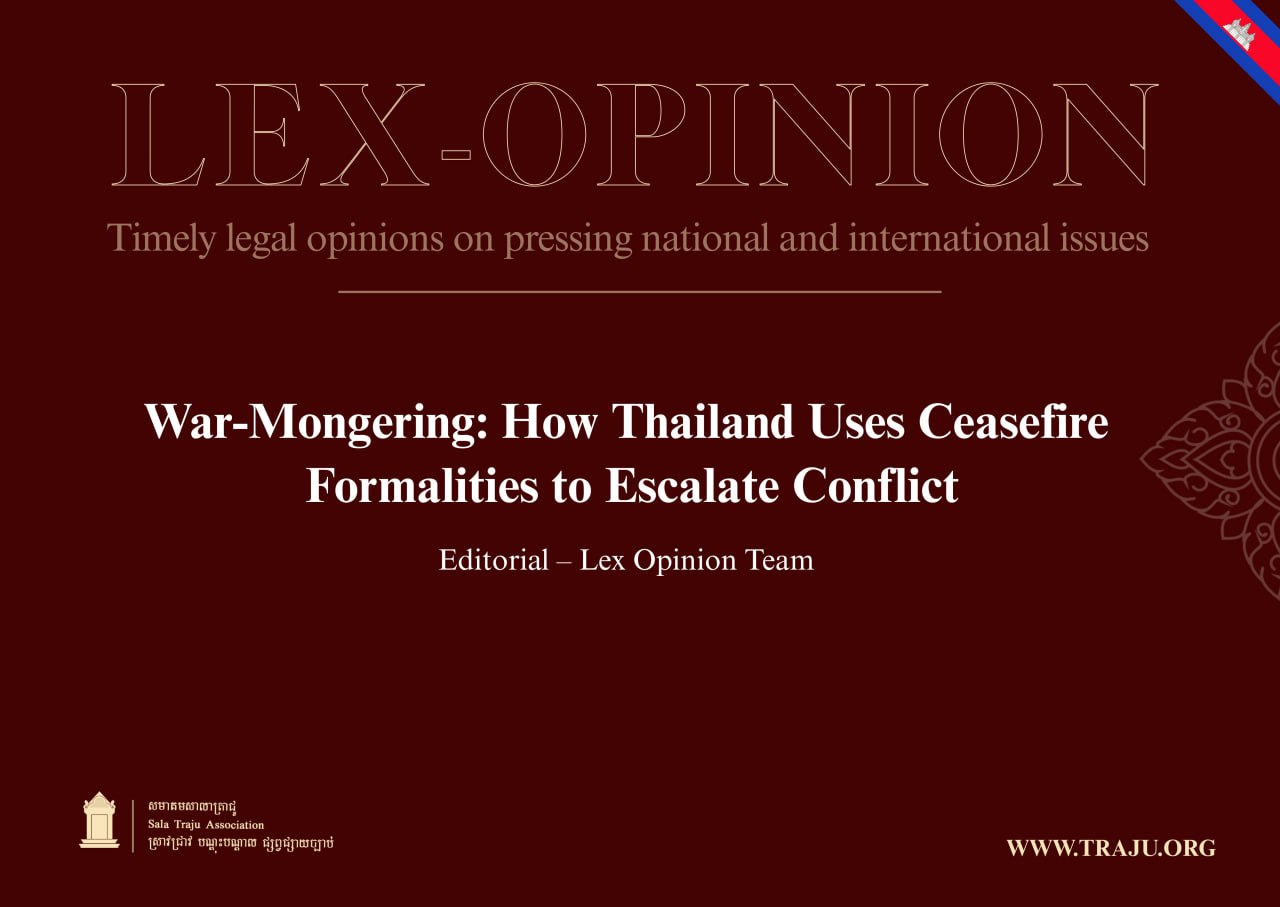
Editorial – Lex Opinion Team
International law is not a matter of convenience. States cannot invoke it when useful, dismiss it when uncomfortable, and then claim the mantle of legality. Yet this is precisely the position Thailand’s foreign minister has advanced in recent public remarks on the Cambodia–Thailand conflict.
Thailand now argues that Cambodia must formally propose a ceasefire, even as Thai forces initiated hostilities and escalated military action. This position inverts international law. A state that fires first cannot demand procedural perfection from the defending party while questioning or sidelining earlier understandings reached through regional and international mediation. To do so is to suggest that consent to peace may be withheld indefinitely, without legal consequence, by the party that first resorted to force.
Ceasefires Are Legal Instruments, Not Political Favors
International law does not require ceasefires to follow a single procedural template. While ceasefires often involve technical annexes and military coordination, they may also arise from unilateral declarations, joint statements, or mediated understandings, provided there is clear intent and subsequent conduct.
This is not controversial. The International Court of Justice has repeatedly affirmed that binding obligations may arise from declarations and agreements reached in diplomatic settings, even outside formal treaty frameworks. What matters is intent, not post hoc regret.
Thailand’s claim that a ceasefire cannot “come by declaration” therefore misstates the law. Worse, it contradicts Thailand’s own conduct. Thailand participated in, and publicly acknowledged, a joint declaration facilitated by international partners. To later argue that such a declaration was “rushed” or insufficiently deliberated does not void its legal relevance.
Under the principle of pacta sunt servanda, agreements must be performed in good faith. A state cannot rely on an agreement to assert violations while simultaneously questioning its validity when compliance is inconvenient.
Denying Proposals While Criticizing Mediation
The Thai foreign minister’s assertion that Cambodia never formally proposed a ceasefire sits uneasily alongside Thailand’s criticism of Cambodia for “internationalizing” the dispute.
If no ceasefire proposal existed, why were ASEAN members, the United States, China, and Malaysia actively engaged in mediation? Why were ceasefire discussions referenced in diplomatic exchanges and regional consultations?
International law does not require a proposal to follow a rigid format to be legally meaningful. What matters is whether a party communicated its willingness to cease hostilities and submitted itself to negotiation. Cambodia did both.
To deny this now is not a legal argument. It is an attempt to reframe the historical record.
Cambodia’s Conduct Meets the Legal Threshold for Self-Defense
Under Article 51 of the United Nations Charter, states retain an inherent right of self-defense if an armed attack occurs. That right is conditioned by necessity and proportionality, not by rhetorical symmetry.
Cambodia has not initiated hostilities. It has not launched pre-emptive strikes. It has not expanded the conflict geographically or temporally. Its military actions have been reactive, geographically limited focusing on military target, and accompanied by repeated calls for ceasefire and mediation.
These facts matter. Self-defense is assessed by conduct, not accusation. Cambodia’s behavior aligns with the core requirements articulated in international jurisprudence and state practice.
By contrast, continued escalation coupled with rejection of ceasefire discussions risks violating the duty to pursue peaceful settlement of disputes, enshrined in Article 2(3) of the UN Charter. This obligation is not optional. It binds all states equally, regardless of relative power.
Bilateral Mechanisms Were Contested, Not Rejected
Thailand’s claim that Cambodia rejected bilateral mechanisms is inaccurate. Cambodia has never refused bilateral engagement as such. What it has consistently contested are specific disputed actions and interpretations advanced unilaterally by Thailand, particularly where those actions altered the status quo or failed to prevent escalation.
International law does not require a state to remain confined to bilateral processes when those processes cease to function impartially or effectively. Bilateral mechanisms are instruments of peaceful settlement, not legal cages. When they break down, or when one party initiates force, the defending state is entitled to seek regional or international facilitation without being accused of bad faith.
Cambodia’s turn to ICJ, ASEAN and international partners was therefore not a rejection of dialogue, but a lawful response to contested issues that bilateral channels could no longer resolve. Contesting disputed points is not obstruction; it is the substance of dispute settlement itself.
The Legal Cost of Strategic Ambiguity
International law depends on consistency. When states signal that agreements may later be dismissed as rushed, proposals denied as informal, and mediation treated as pressure, they weaken not only specific negotiations but the broader legal order that restrains escalation.
This dispute is no longer solely about territory or border incidents. It is about whether commitments matter, whether ceasefires are approached as legal obligations rather than tactical options, and whether good faith remains a governing principle in regional diplomacy.
Cambodia has exercised restraint, accepted mediation, and invoked law. Thailand now faces a choice: reaffirm its commitments within the legal frameworks it helped build, or continue down a path where denial replaces dialogue and delay substitutes for responsibility.
International law cannot prevent conflict by itself. But when states undermine it through selective interpretation and retrospective denial, they ensure that conflict becomes harder—not easier—to resolve.
 English
  ភាសាខ្មែរ